
Leesburg Resident Lookup Record Paths
Leesburg sits within Loudoun County systems, so a name can lead to several very different records. The right route depends on what needs confirmation. A parcel or deed can document an account or recorded land relationship. A court result can show a party role and procedural status. A historical collection can document a dated mention. None of those results, by itself, establishes that someone currently lives at a particular address. Keep the source, retrieval date, locality, and role beside each result.
| Record route | What it can confirm | Custodian | Access boundary |
|---|---|---|---|
| Parcel or deed | Recorded property or account connection | Loudoun Real Property Search and Circuit Court Clerk | Owner is not necessarily an occupant |
| Court case status | Party role, case number, hearing, status, or disposition when shown | Virginia case information | Documents usually come from the Clerk |
| Voter status | Personal registration, district, polling, or ballot-status service | Virginia Voter Information | Only self or expressly authorized use |
| Vital index or certificate | Public-age event index or eligible certified copy | Virginia Department of Health | Age, identity, and relationship rules apply |
| Credential or entity filing | License, credential, formation, or filing status | Virginia board or commission lookup | Filing address is not an occupancy claim |
Begin with a source tied to the known fact. A case number belongs in the court route. An event date belongs in the vital route. A credential number belongs with its issuing board. For a current property question, retain the parcel PIN, situs address, deed reference, and query date. These details reduce same-name errors and make a later check possible.
Note: A postal city, an old address, or a single index hit needs a second source before it supports a personal conclusion.
Court Details for a Leesburg Resident Lookup
The Virginia case information system is the public status route for Loudoun Circuit Court matters. Select Loudoun Circuit, choose Civil or Criminal, then search by name, case number, or hearing date. General District Court and Juvenile and Domestic Relations Court have separate clerks and schedules. A useful result record preserves the court, division, case number, party role, filing or hearing date, status, and displayed disposition.
| Public search control | Use it to narrow the result |
|---|---|
| Locality and court | Choose Loudoun Circuit before interpreting a case list. |
| Division | Use the Civil or Criminal choice documented by the Loudoun guide. |
| Name, case number, or hearing date | Use the most specific available field, then compare roles and dates. |
| Status or detail link | Record only the procedural information the public screen displays. |
Online status does not mean that every image is downloadable. The Clerk holds the underlying files and copy route. Loudoun General District Court provides public-access terminals at 2 Church Street NE, while J&DR material has stronger restrictions. Avoid treating an allegation, witness entry, juror entry, or party address as a finding or a residency label.
Leesburg Resident Lookup Voter Status
A voter check is deliberately narrow. The Virginia voter status form asks for first name, last name, date of birth, the last four digits of a Social Security number, and locality. It also requires an affirmation that the requester is checking their own information or has express authorization. The service is for an individual status, district, polling, absentee, or voting-history function, not for browsing a street or building a roster.
The linked status form shows the identity fields and authorization step used before a submission.
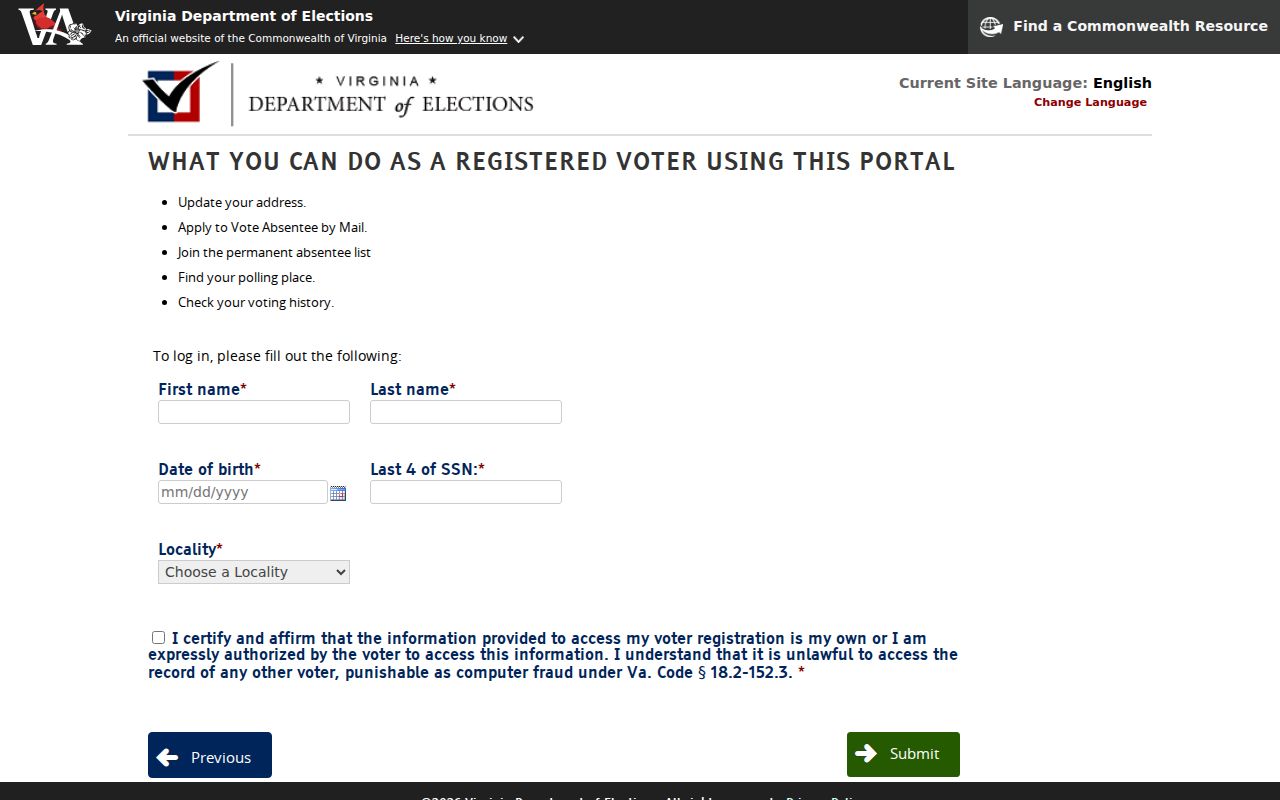
The required fields and confirmation box explain why an individual voter result should remain an individual, authorized check.
Virginia Code §24.2-444 controls public voter-list fields and exclusions. It withholds Social Security numbers, protected address material, declination information, registration-agency identity, and the day and month of birth. The separate voter-list request product has declared client and use categories plus locality, district, election, and date filters. It is not a substitute for narrow, authorized verification.
Leesburg Resident Lookup Vital Records
The Virginia Department of Health Office of Vital Records keeps the state route for birth, death, marriage, and divorce records. Public access begins after 100 years for births and after 25 years for deaths, marriages, and divorces. Virginia Code §32.1-271 also describes a minimum searchable index of name, date, and locality once a record is public. A public-age index and a certified certificate are different products with different access rules.
| Event | Public-age point | Copy route | Leesburg research fallback |
|---|---|---|---|
| Birth | After 100 years | Eligible applicant with identification | Historical index and archive sources where applicable |
| Death | After 25 years | Eligibility and identification review | Balch cemetery and newspaper materials |
| Marriage | After 25 years | VDH or circuit-clerk route as appropriate | Balch marriage books and microfilm |
| Divorce | After 25 years | Certificate and court-file access differ | Ask the proper custodian for the record type |
The current VDH page states a $15 certificate or search fee per copy. A signed application, legible identification, event details, eligibility or relationship information, delivery choice, and payment are required. The online route supports application, payment, and status, while walk-in and mail requests still require the application and acceptable identification.
The VDH online vital-record entry leads to the certificate-order process.
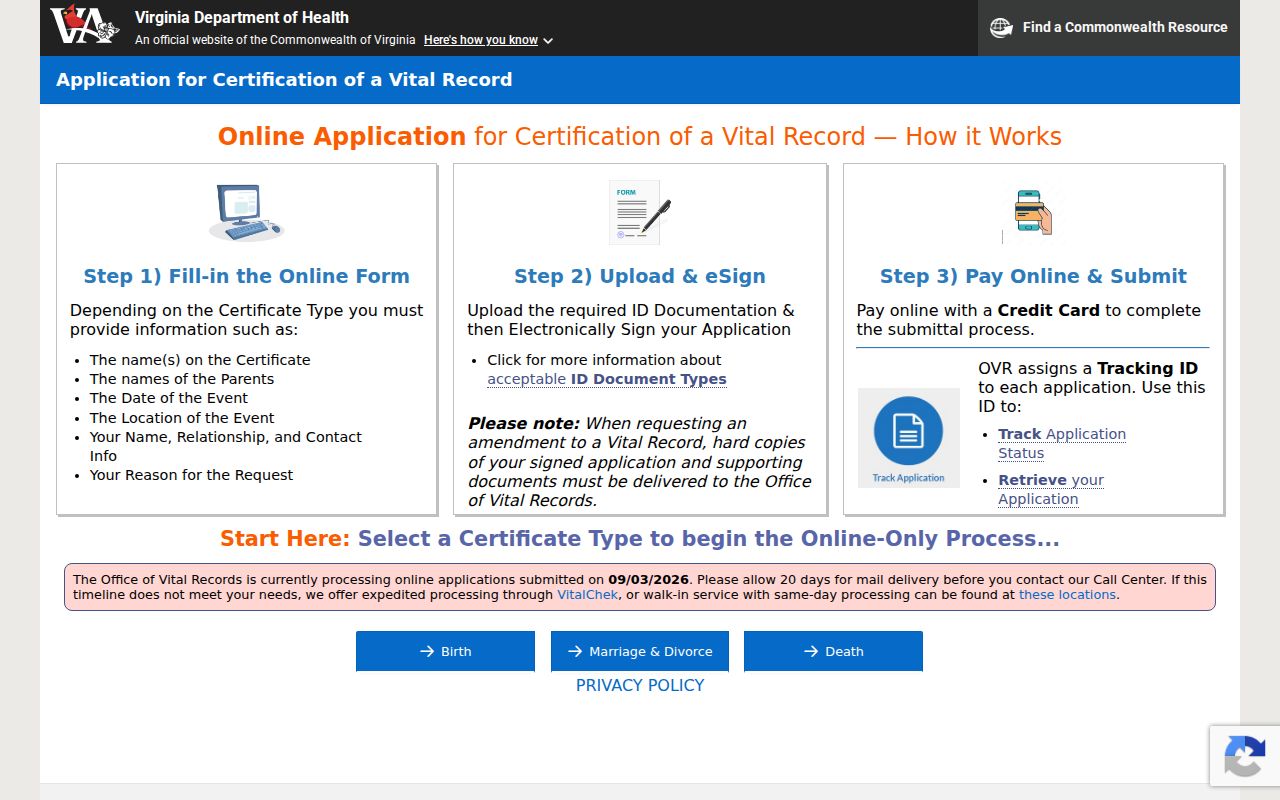
Use the official application channel for an eligible record, and use historical indexes or repositories when an event falls outside the current certificate route.
Verify a Leesburg Resident Across Records
Verification means testing a claimed identity against two sources that serve different purposes. Normalize spelling, include middle initials where available, and note name variants. For a current property connection, compare the parcel record, situs address, deed reference, and retrieval date. For an historical person, combine a dated library, newspaper, census, or directory mention with a deed, tax, church, house-file, or obituary source. The goal is to rule out a similarly named person, not to gather every possible data point.
- Write down the name form, locality, approximate date, and the specific record question.
- Use the relevant official index, such as the court search or an eligible vital index, and retain the exact result reference.
- Compare a second source with a different purpose, such as a deed reference, public role, credential status, or dated Balch item.
- Ask the custodian for a copy only after the correct record and access channel are identified.
- Docket
- A court's running case record, which can show parties, events, dates, and procedural status.
- Index and image
- An index points to a record. An image is the underlying scanned document, which may require a clerk request or different access level.
- Certified copy
- A copy issued by the custodian with certification for an official purpose. It is not the same as an index result.
For a historical household question, Thomas Balch Library can provide dated family files, newspapers, cemetery material, maps, and house files. Its sources explain a person or place at the time recorded. They should not be stretched into a claim about a current private address.
Leesburg License and Entity Checks
A license or entity result is useful when the question concerns a public credential or filing, rather than a person's home. The Virginia SCC entity search uses Entity Name or Entity ID and can display the ID, name, entity type, address, formation date, status, and status date. Record a registered or principal address as a filing field only. It does not establish where an individual lives or where activity occurs.
DPOR License Lookup accepts a free-form name, license number, address, or license type, with an Advanced Search option and a data-current caution. The DHP practitioner lookup supports license number or last-four-SSN with last name, plus occupation, business or person name, state, ZIP, and status. DHP lists current and expired records since January 1, 2000 for free public verification. Save the board, credential type, status, and retrieval date.
Note: A credential or corporate filing can verify a regulated status, but it should never be converted into a personal location claim.
Leesburg FOIA Requests Seek Existing Records
Virginia FOIA, Va. Code §§2.2-3700 through 2.2-3715, is a route to existing public records. It does not require an agency to create a new biography or resident dossier. For Town material, use the Leesburg Public Records and FOIA Center with a narrow description, the responsible department, a date range, desired format, and delivery preference. The Town states that reasonable actual charges can apply and that an advance estimate may be requested.
The FOIA Council describes a five-working-day response framework, possible extensions, exemption explanations, actual-cost rules, estimates, and deposits for larger requests. Preserve the request date, tracking number, response, exemption citation, redactions, estimate, and delivery format. Court, voter, vital, and protected-address material remain subject to their own rules even when a request is framed under FOIA.
Balch Sources Add Leesburg Record Context
When a name appears in older material, local history can supply useful context without turning a historical mention into a current identity claim. Thomas Balch Library collections include family and historic-house files, cemetery indexes, newspapers, maps, tax records, oral histories, and visual material. The library's microfilm index identifies town council minutes from 1858 to 1982, local newspaper runs, deeds, wills, church records, telephone reels, and Sanborn map years.
Search the catalog or index first, then request an item by its identifier and preserve the collection, date, and page. A family file, obituary, cemetery item, or newspaper notice can help distinguish names across decades. It does not prove present residence. This dated-source method is especially useful when a court or vital index provides a name but not enough context to separate two people with similar names.
Leesburg Resident Lookup Privacy Boundaries
Virginia's Address Confidentiality Program, Va. Code §2.2-515.2, provides a substitute address and mail forwarding for eligible survivors who recently relocated after domestic violence, stalking, sexual violence, child abduction, or human trafficking. A protected physical address must not be exposed from a parcel, voter, court, or business source. The program is free, begins with a three-year term subject to renewal, and has defined limits. Use the Virginia Address Confidentiality Program for eligibility information.
Use only the smallest amount of information needed for a lawful, personal verification. Do not combine unrelated individual records into a profile, republish protected identifiers, or treat an address, court role, filing, or historic mention as proof of a current personal fact. Questions about a correction, redaction, certificate, court document, or voter record belong with the original custodian.
Lawful use. Use a Leesburg resident lookup for personal records research and careful verification. Never use record details to stalk, harass, intimidate, or expose a protected person.