
Leesburg City Directory Sources
Thomas Balch Library is the local starting point for city-directory research in Leesburg. Its collection guide combines cataloged local material with microfilm, family files, historic-house files, maps, newspapers, census reels, and deed and will indexes. The library is town-owned and keeps regional material for both Leesburg and Loudoun County. A directory entry gains value when its publication, date, page, and address are kept with the citation rather than copied as a bare name.
The published evidence does not establish an exact Leesburg city-directory publisher sequence or a complete local run. That is an important limit. The most useful coverage map therefore distinguishes a verified statewide guide, Balch holdings that require catalog or onsite checking, and source types that can corroborate an address without being treated as a city directory.
| Collection | Years | Where held | Access |
|---|---|---|---|
| Virginia city and business directory guide | 1801-1929 statewide scope | William & Mary Libraries | Online collection guide; exact Leesburg item needs verification |
| Virginia directory collection | 1873-1960 statewide scope | Genealogy collection with Library of Virginia originals noted | Collection-specific access |
| Leesburg telephone and local-history reels | Runs vary | Thomas Balch Library | Catalog and onsite microfilm research |
| Census microfilm | 1810-1930 | Thomas Balch Library | Onsite reels and selected library databases |
| Newspaper and town-minute material | 1811-2012 and 1858-1982, by series | Thomas Balch Library | Microfilm, index, and collection-specific databases |
Start with the collection title and date already in hand. If neither is known, ask the catalog for Leesburg, Loudoun, directory, telephone, gazetteer, and publisher variants before assuming a missing online result means the volume does not exist.
Thomas Balch and Leesburg City Directories
Thomas Balch Library is at 208 W. Market Street in Leesburg, Virginia, and can be reached at 703-737-7195. Its research value is wider than a directory shelf. Census microfilm for Loudoun and Virginia counties runs from 1810 through 1930, while deed and will indexes and microfilm cover most years through about 1904. Newer deed work belongs with the Loudoun Clerk. Balch's family-file series begins around 1984 and continues in a second series from 2019 onward, with indexed family Bible records.
Historic-house research is especially useful when a city directory gives an address but not enough context. The holdings include Lewis/Edwards material, Leesburg Architectural Surveys, African American Architectural Surveys, a 747-file architectural supplement, and Exploring Leesburg, an address and name index made by Balch volunteers. A house file may connect an address with a builder, former owner, style, or local history. It does not establish a current occupant.
Thomas Balch Library
208 W. Market Street
Leesburg, VA 20176
703-737-7195
Collection access
Use the catalog, collection guides, onsite microfilm, and staff-assisted reference routes. Subscription access can be library-only.
Note: Keep the repository, format, and access status with every Leesburg city directory citation, especially when a result comes from a subscription database.
Leesburg City Directory Gaps
William & Mary's Virginia city and business directory landing page gives a documented route into directories from 1801 to 1929, but it did not expose a confirmed Leesburg scan or page during research. The statewide guide is a lead, not proof of a local edition. A separate Virginia directory collection is described as spanning 1873 to 1960, with originals associated with the Library of Virginia, but that range also cannot be converted into a Leesburg run without checking the item.
The 1917 Virginia Business Directory and Gazetteer is a useful Leesburg sample. Its Leesburg section gives a town heading and a population note before business and person entries. It is not a complete household roll. Record its printed title, volume or part, page, entry type, address if present, and image URL before using it as evidence.
The William & Mary collection landing page shows the statewide discovery route used for the directory search.
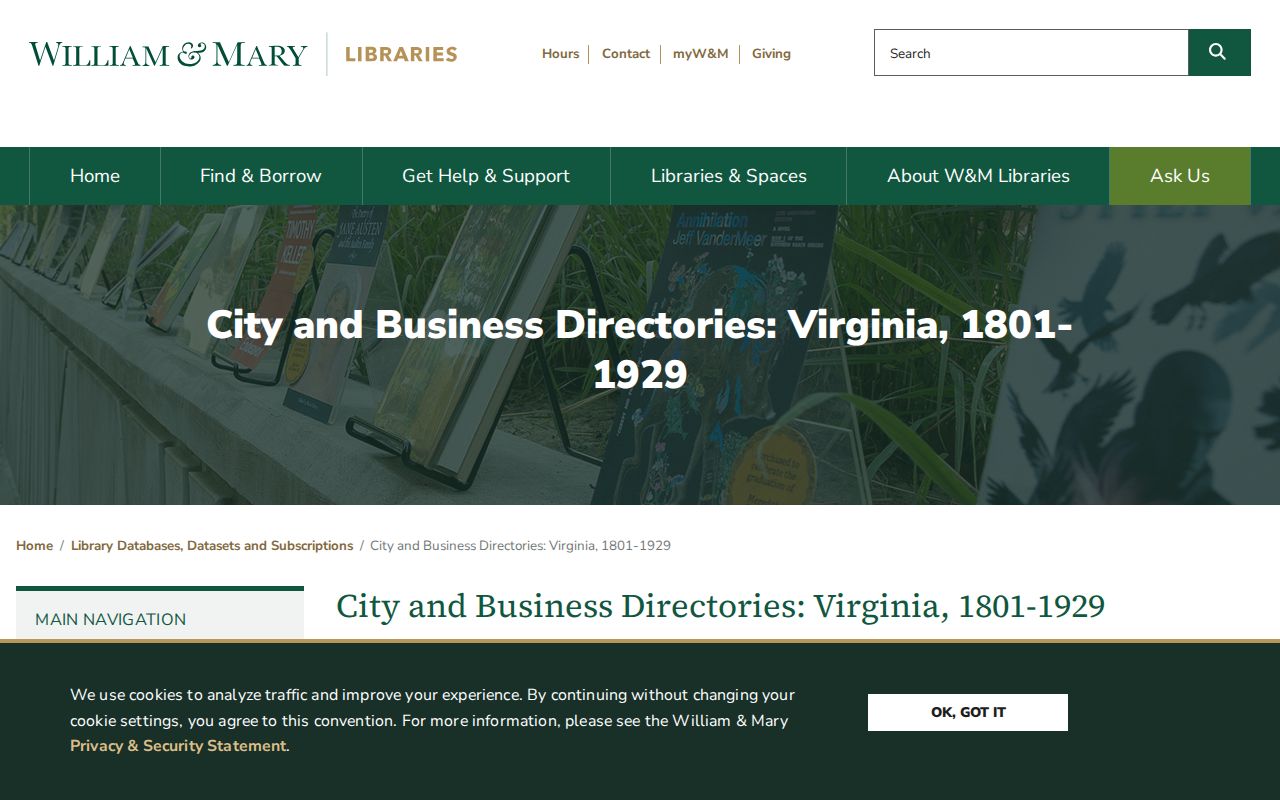
Use the landing page to locate an edition, then verify its Leesburg coverage in the catalog or scan rather than treating the statewide date range as a local publication list.
Reading Leesburg City Directory Entries
A city directory entry is strongest when treated as a compact historical observation. The research record should capture the publication title, publisher, year, page, street or address, name, occupation or organization field, household or business companions, and source location. Those fields are the verified inventory for a Leesburg entry. Do not add an owner mark, spouse notation, or abbreviation meaning unless it appears in the exact volume being used.
| Publication and year | Identifies the edition and prevents a later reprint from being mistaken for a contemporary listing. |
|---|---|
| Page and heading | Preserves where the entry appeared, including a Leesburg section in a statewide business volume. |
| Name and address | Supports a time-specific address comparison after spelling and street variants are checked. |
| Occupation or organization | Can distinguish similar names, but it describes the entry's date and context only. |
| Companions and source location | Records household or business context and whether the item was a scan, microfilm reel, or onsite file. |
- Criss-cross directory
- A directory section arranged by address or street rather than by surname. Its presence in a particular Leesburg volume must be verified.
- Householder index
- An index that points to the named household entry. It is not a substitute for reading the original line and edition.
- Abbreviation key
- The volume's own guide to shortened terms and symbols. Photograph or transcribe it with the entry before interpreting a mark.
Leesburg City Directories Beside Maps
Street wording is part of the search. Carolina Road corresponds to present-day King Street and U.S. 15, while Potomac Ridge Road corresponds to Market Street and Virginia Route 7. Loudoun Street was once the principal east-west street and later became Fayette Street. Preserve the old and current forms beside each directory citation. That practice helps when a directory, deed, newspaper notice, and map use different labels for the same route.
Balch's microfilm index lists Leesburg Sanborn maps for 1886, 1894, 1899, 1903, 1907, 1912, and 1930. Compare the correct sheet, block, street, footprint, construction notation, use, outbuildings, and nearby landmarks. A map symbol can clarify a place's historic form, but it cannot identify a present-day resident.
- Retain the directory address exactly as printed, including its street form.
- Search the historic and current road names in the Balch catalog, newspaper index, and deed references.
- Compare the address with the relevant Sanborn sheet and record the sheet date.
- Use the deed's lot, plat, acreage, and adjoining-owner clues when a number no longer aligns.
Tracing Leesburg City Directory Families
Follow a household through dated sources, not a presumed uninterrupted annual run. Balch census microfilm provides Loudoun and Virginia coverage from 1810 through 1930. Local newspapers include the Washingtonian from 1811 to 1879, the Mirror from 1865 to 1902, and later Loudoun titles through 2012. Town Council minutes cover 1858 to 1982. Together, those series can explain a move, a business listing, a civic appearance, or a gap between directory evidence.
- Locate the earliest confirmed directory, telephone, or gazetteer entry and capture the full citation.
- Check the next available local source, recording address, name variant, and context rather than assuming every year exists.
- Pair the dated entry with the closest available census microfilm year and compare the household carefully.
- Use the newspaper index, cemetery material, family files, or probate research only for the relationship or date each source supports.
- When a modern confirmation is needed, use the appropriate official record instead of extending an old directory listing forward.
A missing name can reflect a move, a changed spelling, a different edition, incomplete coverage, or a listing choice. It is not a finding by itself. The historical collections are a useful starting point; current address-keyed work belongs with the Leesburg by-street records.
Leesburg City Directory Companions
Balch's electronic-resources route includes the Centennial Catalog, collection guides, library-only subscriptions, and online digital collections. Its listed subscriptions include historical newspaper, directory, court, census, tax, voter, land, military, and genealogy material, but vendor access varies. An online link can be open to the public, while another source from the same landing page can require onsite use. Record that distinction before scheduling a search.
For an obituary or newspaper citation, retain the publication, date, page, headline or notice type, and whether it is an obituary, legal notice, social item, or news story. The Loudoun County Newspaper Index has uneven update dates by alphabet range, so a negative name search needs a check of the index's coverage and the underlying reel. Family files, cemetery records, church material, oral histories, and visual collections can add local context without replacing the dated directory citation.
Note: An index hit, obituary, or address listing identifies historical evidence, not a conclusion about where a named person lives now.
Leesburg Directory Sources in Time
No verified first or last printed Leesburg city directory date was located, so the timeline follows the dated sources that frame directory research instead. It helps match a listing with the records most likely to confirm its street, household, property, or local event.
- 1757: Loudoun County began keeping the deed and historic records that form the earliest property trail.
- 1759: The revised Leesburg town plan fixed the early street grid whose road names still matter in older citations.
- 1810-1930: Balch's Loudoun and Virginia census microfilm provides household context for selected directory-era questions.
- 1858-1982: Leesburg Town Council minutes add a municipal record series for addresses, projects, and local decisions.
- 1886-1930: The seven listed Sanborn years supply dated building and block context for historic street entries.
The timeline is a cross-checking tool, not a substitute for an edition citation. Preserve the actual source title, date, page, and access route with any name or address found.
Leesburg Records That Endure
Loudoun County's record trail reaches to its 1757 creation, and the Clerk describes the historic collection as having escaped destruction by fire, war, and environment. That survival makes early deeds, wills, court material, tax sources, and related Balch holdings unusually helpful beside Leesburg city directories. It does not erase individual gaps or incomplete indexes. Cite the format and source date every time a historical name or address is carried into a family or place history.
Recent Balch cataloging and digitization work can change what is remotely discoverable. Check the catalog, the collection guide, and the office holding the original before relying on an old search result.