
Leesburg Address Record Sources
A Leesburg address trail changes by era. The current parcel card, GIS geometry, and recent deed point into the recorded land chain. Older work shifts to historic deed books, index PDFs, tax material, maps, newspapers, census reels, and Balch house files. Each source answers a different question. A deed can identify parties to an instrument. A census can describe a household at its enumeration date. A map can show a building footprint. None proves every person who lived at an address.
Begin with the most recent solid property reference, then choose the next source by date. The table keeps the route local and makes clear where the public record changes from a current portal to microfilm, an index, a book, or an onsite collection.
| Source | Years it covers | Where held | What it shows |
|---|---|---|---|
| Historic deed index and deed books | 1757-present; public PDF indexes through 1903 | Loudoun County Clerk | Parties, book or instrument reference, legal-description trail |
| Early deeds, wills, tithables, and papers | 1757-1812 | Clerk and Balch collections | Early lots, roads, owners, and household context |
| Incorporation-era records | 1813-1833 | Clerk, Balch, and local collections | Town ownership and civic context |
| Antebellum deeds and census sources | 1833-1857 | Clerk and Balch | Transfers, households, trades, and organizations |
| Deeds, street history, and postwar sources | 1857-1878 | Clerk and Balch | Street changes, ownership, newspapers, church, and tax context |
| Deed indexes, Sanborn, and local press | 1878-1903 | Clerk and Balch | Downtown property chain, building footprints, and notices |
| Sanborn, telephone, newspapers, and census | 1903-1960 | Balch and collection-specific sources | Building change, address history, and household context |
| Assessment, GIS, deeds, permits, and Town records | 1961-present | County and Town systems | Current parcel and public-record context |
Note: A dated record supports only the role and period it documents, so keep owner, occupant, party, and historical mention as separate labels.
Leesburg Records at the Clerk
The Loudoun County Clerk of the Circuit Court records deeds and maintains land records stated as reaching from 1757 to the present. For a backward property trail, use the current parcel PIN and deed reference to locate the instrument. The named grantee is the buyer in that transaction. The grantor is the seller. Follow the prior owner's acquisition by searching that person as grantee, while testing every result against the same legal description, lot, acreage, road, plat, and adjoining-owner clues.
The Loudoun TrakRecord portal is the remote land-record route captured for this research.
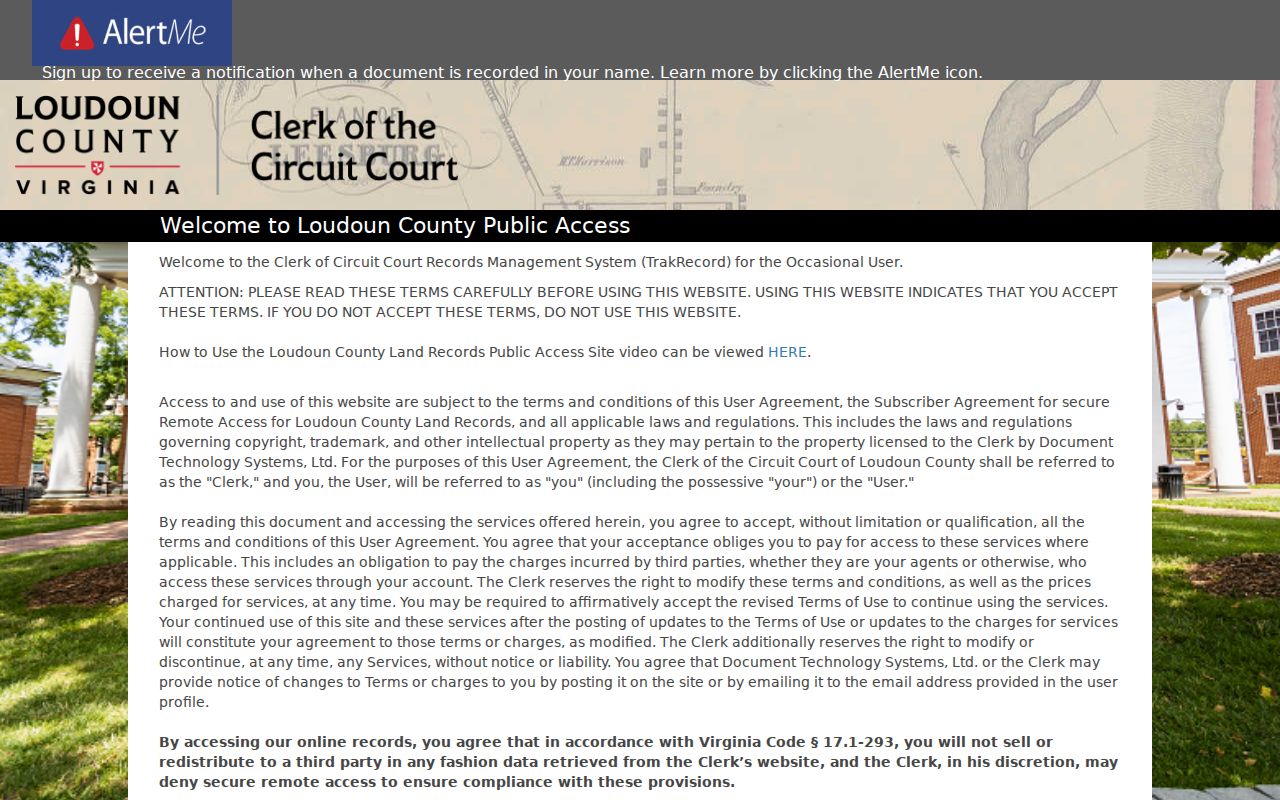
TrakRecord requires a username and password, and its images are behind an account and purchase process. The public research record did not establish a remote image cutoff. Use the historic PDF indexes and the public terminals as the baseline when an image is not available online.
The Clerk asks researchers to provide an exact document or index reference rather than conduct an open-ended title or family search. Copies are generally $0.50 per page, and certification is an additional $2. In-person access is at 18 E. Market Street, Leesburg, Virginia 20176. Mail requests go to P.O. Box 550, Leesburg, VA 20178.
Leesburg Historic Record Indexes
The Clerk's historic deed indexes divide the early search into six PDF ranges: 1757-1812, 1813-1833, 1833-1857, 1857-1878, 1878-1893, and 1893-1903. Use the range that contains the expected recording date, capture the named parties and reference, then continue into the deed book or terminal record. The plat reference index is not all-inclusive, because many plats were embedded in deed books from 1757 into the middle of the twentieth century.
Loudoun Historic Records Indexes provides routes for deeds, wills, court material, and other archive indexes needed when the property history moves past a single deed series.
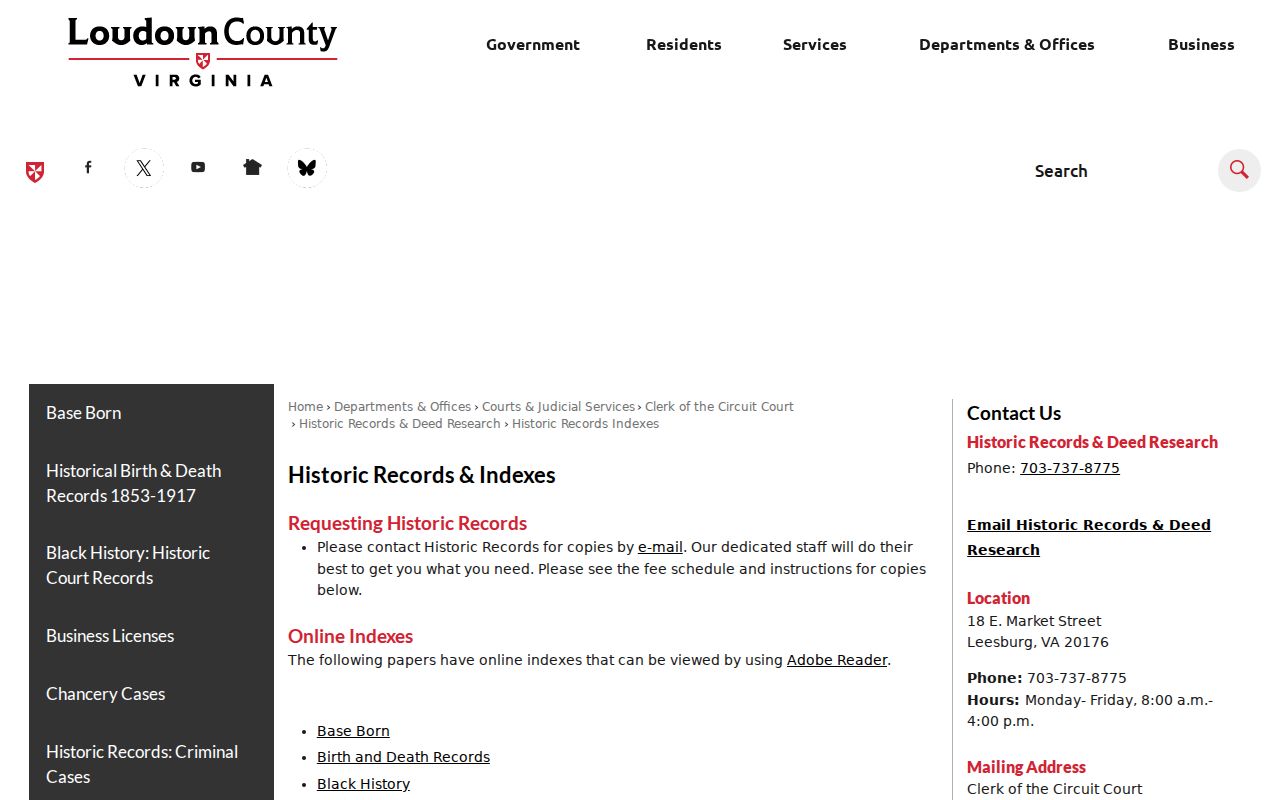
These index routes help move backward through local records, but a matching surname alone is not enough. Compare the legal description and the property clues carried forward from the later instrument before adding a party to the address chain.
Trace Leesburg Property Records Through Deeds
A chain of title is the sequence of recorded transfers for the same land. Street numbers can change, parcels can be divided or combined, and a similar surname may identify a different family. The legal description is the stable bridge. It can describe a lot and block, subdivision, metes and bounds, easement, acreage, road, or plat reference. Capture it at every step, along with deed book and page or instrument number, execution and recording dates, grantor, grantee, and any linked plat.
- Search the Loudoun Real Property Search by the address, PIN, tax map, or ZIP and retain the parcel identifiers and legal-description data available.
- Use the displayed deed reference or the Clerk's records to inspect the most recent recorded transfer.
- Record the grantee and grantor, then look for the seller's earlier acquisition as grantee, not merely as a matching name.
- Compare the legal description, lot, acreage, road, plat, spouse or heir references, and adjoining-owner clues before accepting the link.
- Repeat backward until a historic PDF index, deed book, terminal, or collection limit changes the access method.
- Grantor
- The party transferring an interest in a recorded instrument, commonly the seller in a deed.
- Grantee
- The party receiving that interest, commonly the buyer in a deed.
- Chain of title
- The documented sequence of transfers for the same property, tested with the property description rather than names alone.
- Legal description
- The deed language that identifies land by its lot, subdivision, measurements, easements, or other property terms.
Leesburg Property Records and Addresses
Property ownership and a mailing address are not proof that someone lived at the property. The assessor may show where an owner receives mail, while the situs address identifies the property location. A tax record can distinguish an owner and mailing address from a separate situs address, or show “NO SITUS ADDRESS.” Keep those fields separate from the postal city, ZIP, parcel geometry, Town boundary, and record date.
Loudoun WebLogis supplies the map side of the trail through address or PIN searches, parcel selection, plat-file information, adjoining parcels, and distance tools. Its public help marks owner-address queries as internal only. The map can confirm geometry and an adjoining relationship, not a household or current residency.
Leesburg House-History Records
After the deed chain identifies the right place, move to Thomas Balch Library's collections for the historic-house layer. The library holds Historic House Files, Lewis/Edwards material, Leesburg Architectural Surveys, African American Architectural Surveys, a 747-file supplement, and Exploring Leesburg. Family files, newspapers, maps, visual collections, oral histories, deed and will microfilm, and local tax material can add an address, name, date, or neighborhood detail to the land record.
The seven listed Leesburg Sanborn years are 1886, 1894, 1899, 1903, 1907, 1912, and 1930. Check the map sheet, block, street, footprint, use, material notation, outbuildings, and nearby landmarks. The Library of Congress 1886 Leesburg Sanborn map is a public-domain, two-sheet online source. A footprint or use mark describes the map's date, not a current person.
For directory editions, telephone reels, family files, and their access limits, use the Leesburg city directory collections route instead of assuming every source has an address-first index.
Leesburg Household Record Trails
Owners are only one part of a house history. To find who lived here before, pair a confirmed property address with the closest available directory or telephone entry, the appropriate census microfilm, and local newspaper evidence. Balch holds census microfilm for Loudoun and Virginia counties from 1810 through 1930. Its newspaper holdings include the Washingtonian from 1811 to 1879, the Mirror from 1865 to 1902, and later Loudoun titles through 2012.
- Write down the date span supported by the deed chain before looking for a household.
- Search the nearest available dated directory, telephone, gazetteer, or census source, retaining its title, year, page, and address wording.
- Compare name variants and street forms with the deed's legal-description trail and the historic map.
- Use a newspaper notice, cemetery source, probate record, or family file only for the relationship and date the item states.
Leesburg Historic Roads and Records
Leesburg's 1759 plan and old road names can unlock an address trail that a modern street query misses. Carolina Road is now King Street and U.S. 15. Potomac Ridge Road is now Market Street and Virginia Route 7. Loudoun Street was the early main east-west street and later became Fayette Street. Preserve both forms, plus the record date, when searching deeds, newspapers, maps, and house files.
Loudoun's unusually intact historic collection survived fire, war, and environmental destruction, according to the Clerk. That preservation helps early property research reach back to 1757, but it does not eliminate gaps in indexes or prove a continuous residence. A dated source chain remains the best safeguard against a compelling but unsupported house story.